What a low block, a false nine and a double pivot actually mean
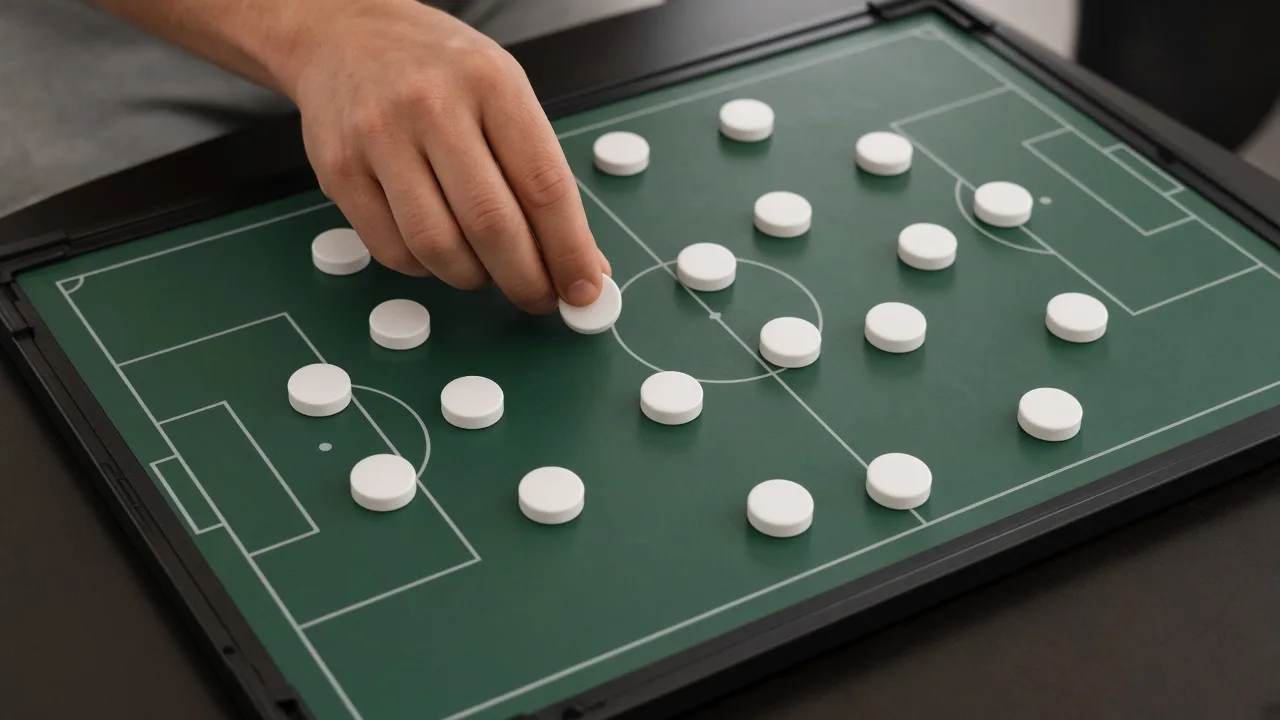
This is a glossary of tactical labels managers and head coaches actually have to choose between. It is not a match preview, and it does not tell anyone how to set up on Saturday. Each entry is tied to a Premier League page that was open on 21 November 2026. Where that page gives a date, the date is in the entry. Where it describes a match, the description is of that match, not of the table today.
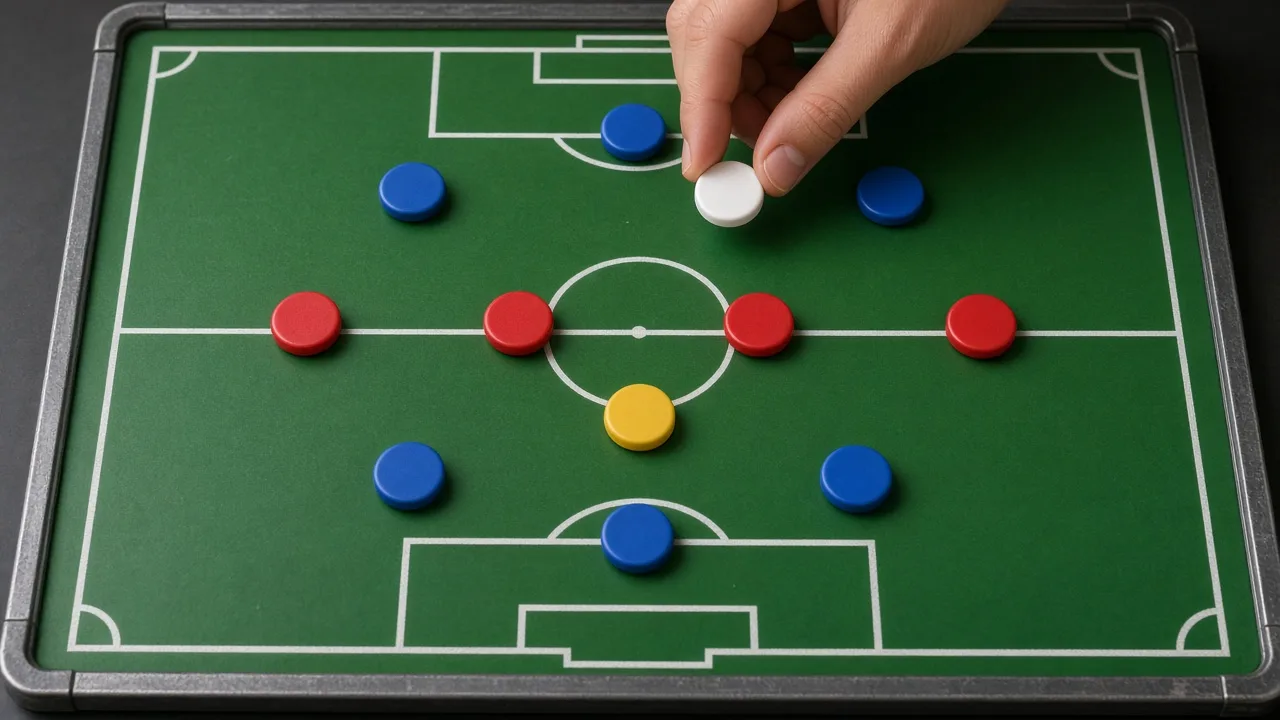
The pages are the league’s own Coaches’ Voice explainers, plus one Adrian Clarke column on the same site. Club crests do not appear here. The pitch diagrams are original sketches of roles. They are not photographs, not a filmed match, and not a picture of a real player. Photographs elsewhere on Decide Football are labelled on the image policy.
The three labels people ask about first are the low block, the false nine and the double pivot. The longer explainers already on this site are what a false nine is and what a double pivot is. This page is the table those two sit in, with the neighbouring words.
| Term | In one line | Primary page |
|---|---|---|
| Low block | A deep spell of defending, protecting the penalty area while the other team has the ball. | Premier League, 24 Feb 2025 |
| Mid block | A compact shape, higher than that deep spell. The guides name it. They do not mark it in yards. | Premier League, 20 Jun 2025 |
| High press | The forward starts it. A No 10 either joins or stays to mark the pivot. | Premier League, 8 Feb 2025 |
| Counter-press | Pressure in the moments after the ball is lost, not a separate formation. | Premier League, 22 Jun 2025 |
| Double pivot | Two deeper central midfielders ahead of the defence. | Premier League, 8 Feb 2025 |
| Single pivot | One deeper midfielder in that same space. The pair came later. | Premier League, 8 Feb 2025 |
| Box midfield | Two pivots and two No 10s, four players in a box. | Premier League, 22 Jun 2025 |
| Inverted full-back | A full-back who steps into midfield while that team has the ball. | Premier League, 22 Jun 2025 |
| False nine | A centre-forward who drops into midfield to pull centre-backs out. | Premier League, 22 Jun 2025 |
Low block
The clearest account on the Premier League site is a match, not a dictionary. Coaches’ Voice, on 24 February 2025, analysed Liverpool’s 2-0 win at Manchester City under the headline of Liverpool’s low block. The piece says Liverpool spent considerable periods of the second half in a low block, covering spaces, protecting the penalty area and limiting City’s attacks. City had plenty of the ball, much of it in Liverpool’s half, and still found few clear chances. Arne Slot’s line, carried in that analysis, was short: “We knew we had to defend a lot.”
The same analysis says what the players actually did, which is more useful than the nickname. Alexis Mac Allister tracked Kevin De Bruyne’s forward runs, sometimes well into the back line. Ryan Gravenberch went the other way, towards Phil Foden when Foden dropped. That let Ibrahima Konate or Virgil van Dijk look after Omar Marmoush and still leave a centre-back spare. The full-backs defended narrow, either side of Gravenberch, with Mohamed Salah and Luis Diaz working back. When Trent Alexander-Arnold was left one against one with Jeremy Doku, Gravenberch stepped across, and Salah and Dominik Szoboszlai covered the passes back inside. The ball was being forced into crowded central spaces.
Two formation guides use the same label without turning it into a measured line on the pitch. The 4-2-3-1 guide of 8 February 2025 says the attacking midfield three and the centre-forward narrow and screen the middle “when in a mid or low block”, and that the far-side wide player tucks in “in a mid-block, low block or when pressing high”. The 4-5-1 guide of 20 June 2025 calls that shape a very effective low or mid-block because of the numbers in central areas. Neither page says “the low block begins at this yard”. The difference they do draw is height and intent: the Liverpool spell is the deep one, spent on the penalty area.
For a manager, the decision is whether to accept a long spell without the ball. Slot’s side did, away from home, and scored with the counters. It is a bad label for any team that is merely losing. Being camped in your own box because you cannot get out is not the same choice as the one the analysis describes.
A later team talk on this site uses the phrase from the other side of the ball. After a 1-0 win over Hull, Mikel Arteta said Arsenal were trying to score a perfect goal against low blocks. The Anfield win of 1 November 2026, rebuilt from the club report and Sky Sports on our game-plan piece, was the reverse picture: Arsenal were the side happy to be compact after an early goal.
Mid block
The 4-5-1 guide does not define a mid-block with a diagram of thirds. It shows coaches. The section titled Eddie Howe’s Newcastle United mid-block says his wide midfielders worked back so the full-backs were not overloaded. On Dan Burn’s side in particular, the winger’s support stopped a player more often seen as a centre-back being left one against one with a fast winger. The same shape could jump and press. Joelinton, Bruno Guimaraes, Sean Longstaff and Joe Willock are named as the players who pressed across the pitch to help wide regains.
A second picture in that guide is England under Gareth Southgate after Euro 2020. He had been moving away from back threes towards a 4-3-3 or a 4-2-3-1, and without the ball he still favoured a mid-block, either a 4-1-4-1 or a flatter 4-5-1. Declan Rice, as the pivot, often jumped. The No 8s could then push up around Harry Kane, and Kane could force the ball wide.
Read next to the Liverpool low block, the mid-block is the compact shape that has not yet sunk onto the penalty area, and that can still step forward. The league’s writers use both names. They leave the border to the eye. A coach who wants a rule in metres will not find one on these pages, and this glossary will not invent one.
Read next
 Arteta tells Premier League leaders Arsenal to be 'much more chaotic' against low blocks
 Tuchel tells England to attack Spain and make it physical in Nations League decider
 Marco Rose's fast-start plan works as Bournemouth win eighth in a row at Ipswich
 Reedijk's Wide-Left Call on Boyle Pays Off as Hibs Beat Hearts at Hampden
High press
In the 4-2-3-1 guide the high press has a trigger, not a slogan. The centre-forward often starts it. The No 10 either pushes up alongside the forward, so the first line is a flat two, or stays underneath and marks the opposition pivot. Out of possession the same teamsheet can become a 4-4-2 or a 4-4-1-1. The wide midfielder on the far side tucks in, adding a body in the middle. That narrowing is described for the mid-block, the low block and the high press. The height changes. The habit of guarding the centre does not.
The guide is careful about history. It says Manchester City assistant Juanma Lillo is thought to have pushed Spanish football from 4-4-2 toward 4-2-3-1, with the high press a significant reason. “Thought to have” is the page’s own hedge. It is not a record of a single match.
The 3-4-3 guide of 22 June 2025 adds the wide players. When that team presses high, the wing-backs jump and may go as high as the opposition full-backs. The front three either screen passes into midfield or press high, often to force the ball to the touchline and then crowd it there. A high press, on these pages, is a set of jobs for the forwards and the wide players. It is not simply “standing in the opponent’s half”.
Counter-press
Counter-pressing, in the same guides, is what happens in the seconds after the ball is lost. It is not another name for the high press, and these pages do not use the German label gegenpressing. The 3-4-3 guide says a pair of narrow No 10s can counter-press after a loss. The box-midfield guide of 22 June 2025 says the box gives a team numbers for counter-pressing in central midfield, and with the numbers a chance of winning the ball back quickly.
The 4-5-1 guide puts the idea next to a coach who is also associated with the opposite choice. It says Jurgen Klopp’s Liverpool are associated with aggressive counter-pressing, and that he often used a 4-5-1 when he wanted a more compact block. The No 8s still had licence to jump, and the wingers, “especially Mohamed Salah”, were the outlets once the ball was won. One coach, two tools. The glossary treats them as separate entries for that reason.
Double pivot
The 4-2-3-1 guide is blunt. Ahead of the back four stand two deeper central midfielders, “often referred to as a double pivot”. Behind them is the defence. In front are an attacking midfield three and a single centre-forward. The pair link the lines, cover the space in front of the centre-backs, and let both full-backs go forward because someone is still behind the ball. One of them can push on in a transition. Most of the time they stay central.
The 3-4-3 guide puts the same pair in a different house. They sit ahead of three centre-backs. In possession they progress the ball, switch it between the wing-backs and pass into the front three. On a counter they look for a wide forward running in behind. Without the ball they stay connected to the back line, especially while the wing-backs are still running back. If the team has two No 10s, that cover is what is left when the press is beaten.
The 4-2-3-1 guide’s Manchester City section is the worked example. In 2020/21 Pep Guardiola used that shape more often than in any earlier season at the club. Rodri played in a double pivot with either Ilkay Gundogan or Fernandinho. Joao Cancelo moved forward from left-back, and central rotations let Gundogan push on while Cancelo joined Rodri so the pair stayed at two. The longer account of those choices, and of what a manager gives up by picking two holders instead of one, is our double-pivot explainer.
The guide also records the hole. One of the pair can slide across to cover a full-back who has attacked. The other is then alone, and a switch of play to the far side can miss both of them. Two holders are not a lock on the counter-attack.
Single pivot
The double pivot has a predecessor, and the same guide names him. The 4-2-3-1, it says, grew out of teams in the late 1990s who used a withdrawn centre-forward in a 4-4-2. The answer to the space between the lines was first a single pivot. “Claude Makelele was the most notable of these.” A second defensive midfielder was added later, in front of the back line. The page presents that as a change of fashion and of pressing, not as a law.
There is a modern picture of the single holder in the 3-4-3 guide, under Mauricio Pochettino at Tottenham and Southampton. He often reached a 3-4-3 from a 4-3-3. The single pivot dropped between the centre-backs and split them. The full-backs went on as wing-backs. The wingers came inside to help the centre-forward. One player moving backwards changed the whole back line.
The manager’s choice between the two entries is the choice the history describes. One holder frees a teammate to play higher. Two holders were added when that one player was not enough cover for the space in front of the defence, and not enough support for the press. The pages do not publish a win percentage for either choice.
Box midfield
The box-midfield guide of 22 June 2025 defines it by a count. Four players: two deeper pivots and two No 10s, arranged so the positions resemble a box. In possession the job is to keep the ball, move it up the pitch and create for the forward line. The pivots receive from the centre-backs, often under pressure from behind, and look for the 10s or for wide runners. The 10s, also pressed from behind, try to break the last line with a through ball, a narrow cross, a dribble or a combination. They are expected to receive in behind, attack crosses, shoot, and score a decent share of the goals.
Without the ball the pivots block, cover and screen the middle, compete for direct balls, and track runners. The 10s help a high press, including jumping onto centre-backs, or, in a more reserved block, screen the pass into central midfield.
The examples are specific. At Chelsea, Thomas Tuchel used two from Mateo Kovacic, Jorginho and N’Golo Kante as the deeper pair in a 3-4-3. The 10s came from Mason Mount, Christian Pulisic, Hakim Ziyech and, at times, Timo Werner and Kai Havertz. In the second half of Manchester City’s 2022/23 treble season, Guardiola moved John Stones from the back line into midfield alongside Rodri, and Kevin De Bruyne and Ilkay Gundogan played higher, at the top of the box. Klopp’s version sent Alexander-Arnold inside from right-back so his passing could find the runners. The guide also notes a Red Bull habit: a narrow 4-2-2-2 in which the wide players move inside and become the two 10s.
The disadvantages are written down, which is why the entry is worth citing. The pivots and the 10s often stand on the same vertical lines, so an opponent can block the pass from one to the other. Width can go missing because so many players are inside. And a team that defends the centre with its own numbers can keep the box in a small space and limit the chances. A box is an overload only if the other midfield is smaller. A packed defence removes the point.
Inverted full-back
The box guide is also the page that says what an inverted full-back is doing. “In some cases, one pivot may be an inverted full-back who has moved into midfield when their team is in possession.” More often, it adds, both pivots are simply midfielders. The full-back who steps inside is a way of building the pair, not the usual way.
The names in that guide are Philipp Lahm at Bayern Munich, Joao Cancelo and Oleksandr Zinchenko at Manchester City, and Alexander-Arnold at Liverpool. Guardiola’s Stones move is listed next, and it is a different starting job: a centre-back leaving the back line to stand next to Rodri, not a full-back coming off the touchline. The idea is related. The position on the teamsheet is not.
The guide’s warning is the useful part. Players who change this much between their shape without the ball and their shape with it “are extremely specialist and so quite rare”. Few teams, “even at the very highest level”, have them sitting around. Calling every attacking full-back inverted is how the word stops meaning anything.
False nine
The 3-4-3 guide gives the movement in one sentence. One option is for the wide players to attack centrally “while the striker plays as a false nine”. The forward drops into midfield “to try and drag the opposing centre-backs out of position”. That is the whole mechanism. If the centre-back follows, the space he leaves is what the wide player is running into. If the centre-back stays, the dropped forward is an extra player between the lines. The longer explainer on this site walks through that choice and the ways it fails.
The 4-2-3-1 guide says Manchester City did this in 2020/21 when Guardiola left out Gabriel Jesus or Sergio Aguero. The false nine was then a midfielder or a winger: Raheem Sterling, Riyad Mahrez, Phil Foden, Bernardo Silva or Ferran Torres. Clarke’s column of 28 May 2021, How Man City became champions: Changing formations, calls the decision to start without a recognised striker the most significant change of that title season. He counts a “false nine” in 13 of 38 league matches. The rotation he names adds Kevin De Bruyne and Ilkay Gundogan to Bernardo, Torres, Sterling and Mahrez.
Two away wins are the ones he picks out: 3-1 at Chelsea in January, and 4-1 at Liverpool a month later. At Anfield, he writes, City were almost in a 2-3-3-2, with Sterling and Mahrez as split strikers and Foden as the false nine. Foden had four touches in the opposition box. He scored and assisted.
The column then shows the cost in a stat the nickname usually hides. City’s open-play crosses fell from 707 in 2019/20 to 432 in 2020/21, and from 18.6 a game to 11.4. That was first in the league for volume, then 16th. Successful open-play crosses went from 134 to 58, and from 3.5 a game to 1.5, second in the rankings to 19th. Clarke’s point is that a team without a striker attacking the box had less reason to cross, and the full-backs attacked from narrower positions. Cancelo’s open-play crosses per 90 went from 3.51 to 2.70, Zinchenko’s from 3.68 to 1.59, Benjamin Mendy’s from 5.17 to 2.64 and Kyle Walker’s from 2.03 to 1.76. The false nine was not a free attacking upgrade. It was a swap: fewer crosses, a different set of runners, and, in Clarke’s telling, a title.
Short answers
What is a low block?
A low block is a deep defensive spell. In the Premier League’s account of Liverpool’s 2-0 win at Manchester City, published 24 February 2025, the side spent much of the second half covering spaces, protecting the penalty area and limiting City despite City having the ball in Liverpool’s half. The league’s formation guides use “low block” for that deeper shape and “mid block” for a higher compact shape. They do not publish a measured line between the two.
What is a false nine?
A false nine is a centre-forward who drops into midfield to try to drag the opposing centre-backs out of position. That is the Premier League 3-4-3 guide’s description, dated 22 June 2025. It is a movement, not a guarantee that the team has no striker on the teamsheet.
What is a double pivot?
A double pivot is the pair of deeper central midfielders who play ahead of the defence. The Premier League’s 4-2-3-1 guide, dated 8 February 2025, uses that name for the two players behind the attacking midfield three and the centre-forward.
Sources
All six pages were opened again on 21 November 2026. Quotes are short and attributed. Figures are the figures printed on those pages.
- Analysis: How Liverpool’s low block nullified Man City (Premier League / Coaches’ Voice, 24 February 2025)
- The 4-2-3-1: football tactics explained (Premier League / Coaches’ Voice, 8 February 2025)
- The 4-5-1 formation: football tactics explained (Premier League / Coaches’ Voice, 20 June 2025)
- The 3-4-3: football tactics explained (Premier League / Coaches’ Voice, 22 June 2025)
- Box midfield: football tactics explained (Premier League / Coaches’ Voice, 22 June 2025)
- How Man City became champions: Changing formations (Adrian Clarke, Premier League, 28 May 2021)
Spotted an error? See our corrections policy.
More on these decisions
What Is a False Nine? Why Managers Withdraw Their Centre-Forward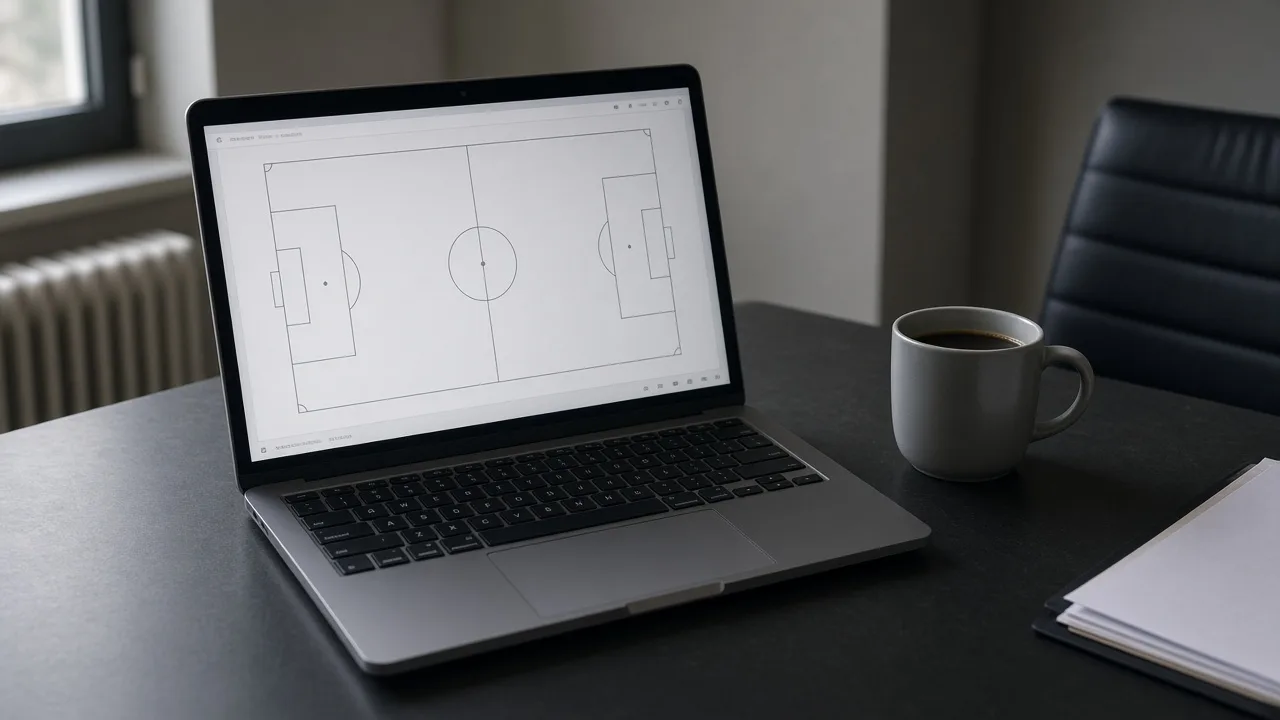 What Is a Double Pivot? The Midfield Choice Behind a 4-2-3-1
 Le Bris's Sunderland overhaul pays off as Talbi starts and Black Cats beat Chelsea
The Decide Football briefing
The biggest managerial decisions from across world football, by email. Free, and you can unsubscribe at any time.