What Is a False Nine? Why Managers Withdraw Their Centre-Forward
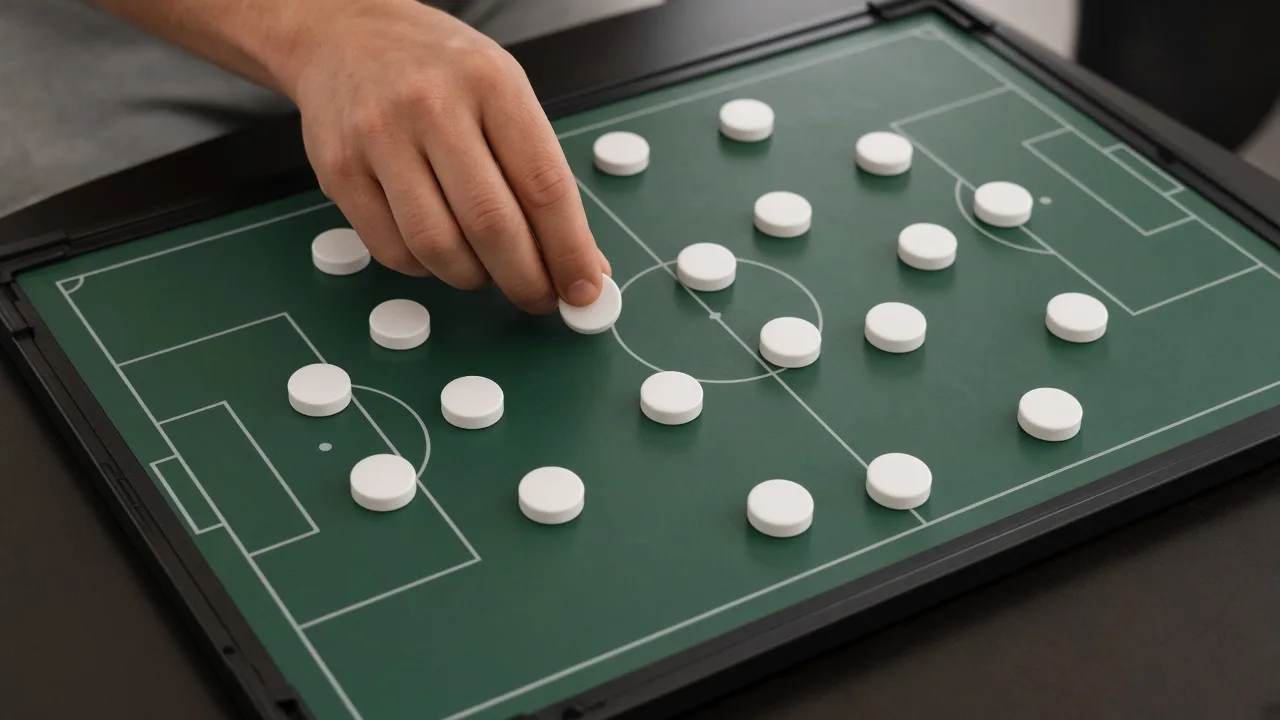
A false nine is a nominal centre-forward who moves away from the opposition centre-backs and into midfield rather than consistently occupying the highest central attacking position. The label describes a movement pattern, not simply a striker who passes well. The manager wants to create a decision for defenders: follow the forward into midfield and leave space behind, or hold the defensive line and allow an extra player to receive between the lines. The Premier League’s tactical guide to the 3-4-3, by Coaches’ Voice and dated 22 June 2025, describes a false nine dropping into midfield to try to drag the opposing centre-backs out of position.
Date checked: 21 November 2026. The three Premier League pages this piece relies on still match the account below: the 3-4-3 guide (22 June 2025), the 4-2-3-1 guide (8 February 2025) and Adrian Clarke’s title column (28 May 2021).
The movement that makes the role work
Picture a team building through two central midfielders against two opposition midfielders. Its nominal striker drops into the space behind those midfielders. If an opposition centre-back steps forward to track the striker, the defensive line loses a central member. An attacking winger can then run diagonally into the space the defender has left. If the centre-back stays, the striker may receive facing forward and combine with a midfielder or winger. The manager is trying to make both responses uncomfortable.
That movement must be coordinated. A false nine who continually drops without anyone running beyond can make the attack easier to defend: the opposition can hold its line, compress midfield and leave no runner threatening the goal. A manager therefore needs at least one forward who attacks depth, usually from a wide starting position. The wide player’s run is not an optional flourish; it is what turns the false nine’s movement into a credible threat.
The role can be used from a 4-3-3, a 4-2-3-1 or a version of the 3-4-3. The team-sheet formation alone cannot identify it. The Premier League’s 4-2-3-1 guide (Coaches’ Voice, 8 February 2025) describes Manchester City using midfielders and wingers as false nines in 2020/21. The important evidence is where the nominal centre-forward receives and what teammates do in response.
Read next
 What Is a Double Pivot? The Midfield Choice Behind a 4-2-3-1
 Arteta tells Premier League leaders Arsenal to be 'much more chaotic' against low blocks
 Marco Rose's fast-start plan works as Bournemouth win eighth in a row at Ipswich
 Tuchel tells England to attack Spain and make it physical in Nations League decider
Why a manager chooses it
One reason is numerical superiority in central areas. When the striker joins midfield, the possession side may have an extra passing option around the ball. That can help a manager whose team wants to circulate possession through central channels rather than repeatedly cross towards a fixed target. Another reason is to disrupt man-oriented marking: a defender who follows the false nine can be drawn into an unfamiliar part of the pitch.
Adrian Clarke’s Premier League column of 28 May 2021, How Man City became champions: Changing formations, calls the decision to start without a recognised striker the most significant tactical change of that title season. He counts a false nine in 13 of 38 league matches. The away wins he highlights are a 3-1 at Chelsea in January and a 4-1 at Liverpool a month later. At Anfield he has City almost in a 2-3-3-2, with Raheem Sterling and Riyad Mahrez as split strikers and Phil Foden as the false nine. Foden had four touches in the opposition box. He scored and assisted.
Clarke also prints the stat the nickname usually skips. City’s open-play crosses fell from 707 in 2019/20 to 432 in 2020/21, from 18.6 a game to 11.4, and from first in the league to 16th. Successful open-play crosses went from 134 to 58, and from 3.5 a game to 1.5, second to 19th. His point is that a side with no striker attacking the box had less reason to cross. Those figures show a manager selecting the approach for particular matches, not a universal rule that every successful possession team must play without a recognised striker.
There is also a defensive calculation. A player who is comfortable receiving centrally can be positioned to contest the first pass after possession changes. But this depends on the whole team’s pressing instructions; simply fielding a midfielder at centre-forward does not automatically create an effective press.
The risks managers have to solve
A false nine can leave the penalty area underoccupied. If both wide forwards come short to receive, there may be nobody attacking a low cross or occupying the centre-backs. The manager must decide who supplies those runs: a winger, an advanced No 8, or a full-back arriving late. That choice also affects protection against a counter-attack, because every extra runner forward is one fewer player immediately available behind the ball.
The opposition can also refuse the invitation. Centre-backs may remain in their line and ask a defensive midfielder to pick up the dropping forward. In that case the false nine has not displaced a defender; the attacking side must find another route, perhaps switching play quickly to isolate a wide defender. A manager should assess the opponent’s marking scheme before deciding whether the false nine is likely to create space.
A further problem appears when the striker receives with their back to goal but lacks support. The tactical idea depends on combinations: one player checks towards the ball, another runs beyond, and a third offers a safe supporting pass. Without those relationships, the false nine becomes an isolated receiver in a crowded area.
A worked match-plan example
Consider a hypothetical Premier League match in which the opponent defends in a compact 4-4-2. The manager starts a 4-3-3, asks the centre-forward to drop just behind the two opposing central midfielders and instructs the left winger to attack the channel between right-back and right centre-back. When the forward receives, the nearest midfielder offers a one-touch return pass while the winger makes the run. If the centre-back steps out, the through-ball becomes available; if not, the forward can turn or recycle possession.
At half-time, suppose the opponent begins assigning a central midfielder to follow the false nine. The manager can respond by keeping the striker higher for several attacks, drawing that midfielder away from the build-up zone, or pushing a No 8 beyond the forward. These are alternatives rather than proof of one correct response. The essential test is whether the movement still creates a useful advantage.
A false nine is therefore best understood as a manager’s spacing decision. It trades the constant presence of a conventional centre-forward against the possibility of an extra central receiver and openings for runners. The value comes from the entire front line’s movements, not from the label attached to one player.
The same movement sits beside the low block and the double pivot in the tactics glossary. The pair in front of the defence is the double pivot. A manager talking about attacking a deep defence, rather than leaving one, is Arteta after the Hull win.
Background
More from Premier League and the Tactics section. Tactical background: What Is a Double Pivot? The Midfield Choice Behind a 4-2-3-1. Labels used in this section are defined in the tactics glossary.
Sources
- The 3-4-3: football tactics explained (Premier League / Coaches' Voice, 22 Jun 2025; checked 21 Nov 2026)
- The 4-2-3-1: football tactics explained (Premier League / Coaches' Voice, 8 Feb 2025; checked 21 Nov 2026)
- How Man City became champions: Changing formations (Adrian Clarke, Premier League, 28 May 2021; checked 21 Nov 2026)
Spotted an error? See our corrections policy.
The Decide Football briefing
The biggest managerial decisions from across world football, by email. Free, and you can unsubscribe at any time.
More decisions
 Reedijk's Wide-Left Call on Boyle Pays Off as Hibs Beat Hearts at HampdenWhat Is a Double Pivot? The Midfield Choice Behind a 4-2-3-1