What Is a Double Pivot? The Midfield Choice Behind a 4-2-3-1
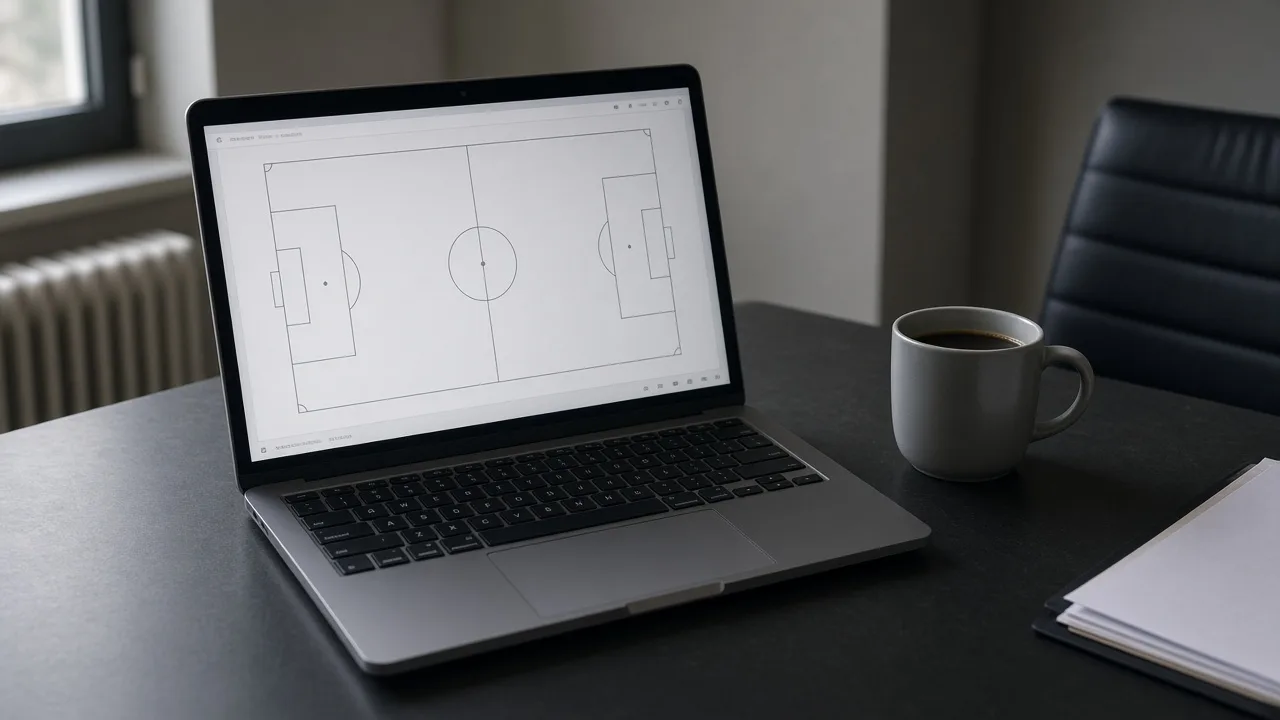
A double pivot is a pair of deeper central midfielders positioned ahead of the defence. In a conventional 4-2-3-1, they sit behind the three attacking midfielders and the lone centre-forward. The Premier League’s Coaches’ Voice guide to the 4-2-3-1, dated 8 February 2025, describes these two players as the double pivot. For a manager, the decision is about how to divide passing, screening and covering duties across two players instead of relying on a single holding midfielder.
Date checked: 21 November 2026. The account below still matches those Premier League pages: the 4-2-3-1 guide (Coaches’ Voice, 8 February 2025), the box-midfield guide (22 June 2025) and the 3-4-3 guide (22 June 2025).
Two midfielders, not two identical jobs
The word ‘double’ can suggest a rigid horizontal line. In practice, the two players can occupy different heights and perform different tasks. One may drop towards the centre-backs to offer a passing angle while the other stays available further forward. When the ball moves to one side, the nearest pivot can support the carrier and the other can protect the central passing lane. Their relationship matters more than whether both stand at the same depth in a still image.
The Premier League’s 4-2-3-1 guide traces the formation’s development to the need to control spaces between defensive and attacking lines. Adding a second deeper midfielder changes how a manager can protect those spaces and build attacks. It does not automatically guarantee defensive security: the pair still need to coordinate with the full-backs and central defenders.
In possession, a double pivot offers two central passing options ahead of the back line. This can help a team escape pressure because a defender may find a short pass on either side. Yet if both pivots stand behind the opponent’s first pressing line without adjusting their positions, they may be covered by the same opponents. Managers therefore coach staggered positions and different body orientations to create useful passing lanes.
Read next
 What Is a False Nine? Why Managers Withdraw Their Centre-Forward
 Arteta tells Premier League leaders Arsenal to be 'much more chaotic' against low blocks
 Marco Rose's fast-start plan works as Bournemouth win eighth in a row at Ipswich
 Tuchel tells England to attack Spain and make it physical in Nations League decider
Why the shape can change during an attack
The formation printed on a team sheet describes a starting reference point, not every phase of play. A double pivot can become part of a box midfield, which the Premier League’s box-midfield guide defines as four players: two deeper pivots and two No 10s. That arrangement gives the manager four central players at different heights, potentially helping possession progress through the middle.
That guide says one of the pivots can be an inverted full-back who steps into midfield in possession, though both are usually midfielders. This means a side starting with one deeper midfielder and a full-back may create a double pivot only when it has possession. Conversely, a side starting with two pivots may allow one to advance, leaving the other to screen counter-attacks. The league’s 3-4-3 guide places a double pivot ahead of a back three, with wing-backs outside that pair. It is a different starting shape from the 4-2-3-1.
These movements require clear rules. If a full-back moves inside to join a pivot, the winger on that side may need to stay wide. If a central midfielder pushes forward, another player must consider the space behind them. A manager is effectively redistributing responsibility across the team, rather than merely moving a magnet on a tactics board.
The choice between one pivot and two
A single pivot can free an additional midfielder to operate higher up the pitch. That can provide more attacking presence between the lines. But the lone holder may face difficult decisions when the opponent uses two forwards to block passing routes. A double pivot can give the defenders another option and distribute defensive coverage, at the cost of having one fewer player starting in an advanced central position.
Consider a hypothetical Premier League fixture against a side pressing with two strikers. A 4-3-3 team with one holding midfielder might find its central passing lane repeatedly blocked. The manager could move an advanced midfielder back alongside the holder, creating a 4-2-3-1 build-up. The two pivots can split across the pitch and try to offer separate angles. Whether that succeeds depends on the opponent’s pressing assignments and the quality of the movement.
The reverse adjustment is equally plausible. Against a deep opponent that refuses to press, the manager may decide two holding players are redundant. One pivot can move into an advanced inside channel, giving the side another player near the opposition defence. The choice should respond to what space is available, not to a fixed preference for defensive or attacking formations.
A documented Premier League example
The 4-2-3-1 guide, in its Manchester City section, says Pep Guardiola used that shape more often in 2020/21 than in any earlier season at the club. Rodri played in a double pivot with either Ilkay Gundogan or Fernandinho. Joao Cancelo moved forward from left-back and often joined Rodri so the pair stayed at two while Gundogan ran from the pivot. When City left out Gabriel Jesus or Sergio Aguero, the same section says Guardiola used a midfielder or a winger as a false nine. The roles were not fixed.
That flexibility also illustrates the risk of reading formations literally. A manager may select a double pivot to secure the initial build-up, then allow one of its members to join the attack once the team has established possession. Observers should look at the team’s shape when the goalkeeper starts play, when it reaches midfield and immediately after losing the ball.
What to watch during a match
Look first at the distance between the pivots. If they are too close, one opponent may screen both. If they are too far apart, the team may struggle to combine through the centre. Next, watch which player drops towards the defence and which supports the attacking midfielder. Finally, track what happens when possession is lost: does one player remain central while the other closes the ball, or do both get caught ahead of it?
A double pivot is not a promise of cautious football. It is a manager’s way of assigning two players to the most contested corridor of the pitch, with the freedom to adjust their duties as the match develops.
The row for this role is in the tactics glossary. For the forward who leaves the last line, see what a false nine is. Recent match calls in the tactics section, rather than further notes on the pivot itself, include Tuchel telling England to attack Spain and Arteta asking Arsenal for more chaotic attacks.
Background
More from Premier League and the Tactics section. Tactical background: What Is a False Nine? Why Managers Withdraw Their Centre-Forward. Labels used in this section are defined in the tactics glossary.
Sources
- The 4-2-3-1: football tactics explained (Premier League / Coaches' Voice, 8 Feb 2025; checked 21 Nov 2026)
- Box midfield: football tactics explained (Premier League / Coaches' Voice, 22 Jun 2025; checked 21 Nov 2026)
- The 3-4-3: football tactics explained (Premier League / Coaches' Voice, 22 Jun 2025; checked 21 Nov 2026)
Spotted an error? See our corrections policy.
The Decide Football briefing
The biggest managerial decisions from across world football, by email. Free, and you can unsubscribe at any time.
 Reedijk's Wide-Left Call on Boyle Pays Off as Hibs Beat Hearts at Hampden